PUBG MOBILE Beginner Guide: Survive the Drop, Read the Zone, Help Your Squad
4 min read
Part of the beginner collection — explore all 10 guides ↗
MAKE IT YOUR READSaved
Build a reliable first-week routine for controls, looting, rotations and squad decisions, with practical advice for MENA players.
Your first PUBG MOBILE win begins before the final firefight. It begins when you choose a landing area you can understand, stop searching for perfect equipment and move before the shrinking play area forces you into a bad route. This guide focuses on Classic battle royale fundamentals, not temporary themed abilities or a promise of rapid rank gains.
Treat the first week as a small experiment. Keep a note after each match: where you landed, why you were eliminated and one decision you would change. Your target is not a spectacular highlight. It is to understand more of the match each time.
Set up a phone you can control
Start with buttons you can reach without moving your whole grip. In training, practise turning, aiming, firing and returning to cover. PUBG MOBILE's official help describes training as a place to try weapons, attachments and movement. Menu locations can change, so use the training option offered by your current client rather than following an old screenshot.
Prefer a graphics setting that stays comfortable during a normal session. Compare performance after several matches, not only in the lobby. If your phone gets uncomfortable to hold, pause. Do not make sensitivity, button layout and graphics changes simultaneously: change one setting, repeat the same exercise and keep a short note.
Players in Amman, Cairo, Casablanca and Riyadh should not assume that one server is best for everyone. Examine the game's connection indicators and coordinate with your squad before changing region. Official support warns that server switching has a restriction period; check the warning in your version before confirming. A VPN is not a guaranteed shortcut to better routing.
Give your first landing a purpose
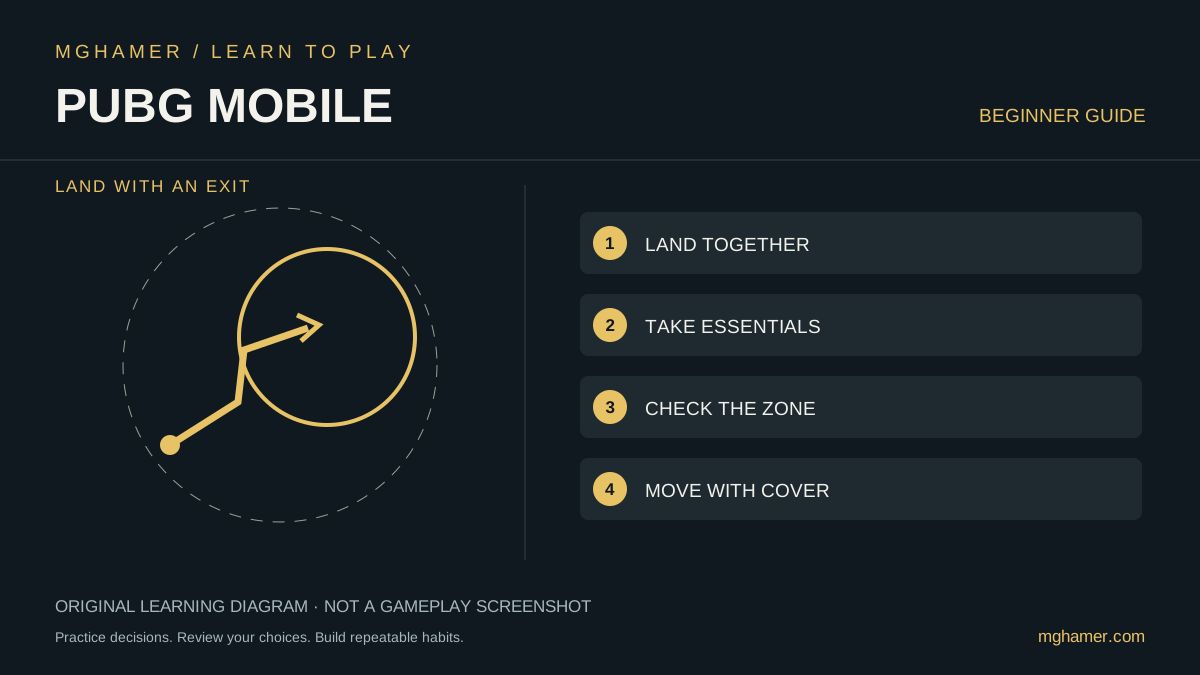
Choose a small group of buildings with an obvious second route out. Before dropping, agree on the area with your team. Land close enough to help each other but avoid all searching the same room. As you descend, look for nearby opponents and decide whether your intended building is still sensible.
Once inside, prioritise a usable weapon, matching ammunition and basic protection. Learn a simple close-to-medium-range setup before collecting unfamiliar equipment. An attachment is useful only if you understand the weapon it changes. Spend your first matches becoming comfortable with what you can actually find, not waiting for a favourite item.
Set yourself a looting question: “Can I defend myself and move now?” If yes, check the map. Reopening every box in a cleared building can cost more than the extra supplies are worth. Tell a teammate about useful spare equipment instead of silently carrying things you will not use.
Move for the next position, not the next shot
When the safe area shifts, choose a destination and a route with usable cover. Do not simply run towards the nearest part of the circle without looking at the ground between you and it. A slightly longer route can be easier to manage if it avoids an exposed crossing.
Imagine your squad hears shots beyond a ridge while the zone requires movement in another direction. Ask whether taking that fight helps you reach safety. If it does not, mark the threat and continue. Resisting an unnecessary battle is a decision, not a failure of courage.
In a squad, use short calls: location, number if known, and your action. “One at the blue house; I am holding this wall” gives your team something useful. When a teammate falls, first consider the enemy's angle and whether you can create a safe rescue. Running into the same sightline can turn one loss into several.
Three mistakes worth fixing first
First: shooting at every distant movement. Before firing, identify cover and an escape route. Second: stopping in the open to compare inventory. Finish those decisions somewhere protected. Third: treating an early elimination as proof that your settings are wrong. Review the landing or positioning error before rebuilding your controls.
A seven-day practice plan
Day one: arrange controls and repeat a short training drill. Day two: use the same modest landing area and learn its exits. Day three: practise finishing essential looting promptly. Day four: mark a safe destination before every rotation. Day five: play with a teammate and practise clear, brief calls. Day six: review three eliminations and name the earliest avoidable decision. Day seven: play a normal session with one improvement goal.
Keep sessions manageable and stop when you are too tired to learn. At the end of the week, compare your notes rather than only your rank: fewer surprised landings, fewer rushed zone crossings and clearer team decisions are progress you can build on.
Sources & further reading
- PUBG MOBILE — Official game websitepubgmobile.com
- PUBG MOBILE Help — Training groundspubgmobile.helpshift.com
- PUBG MOBILE Help — Server change restrictionpubgmobile.helpshift.com
What did you take away?
Real reactions. Thoughtful discussion. Every comment is reviewed before it appears.
Loading reader contributions…
Sign in to join the discussion