How to Read a CS2 Pro Match: Economy, Utility and Map Control
4 min read
MAKE IT YOUR READSaved
Follow the decisions behind a CS2 round: what each team can afford, which space it controls, how utility changes the fight and what to watch beyond the scoreboard.

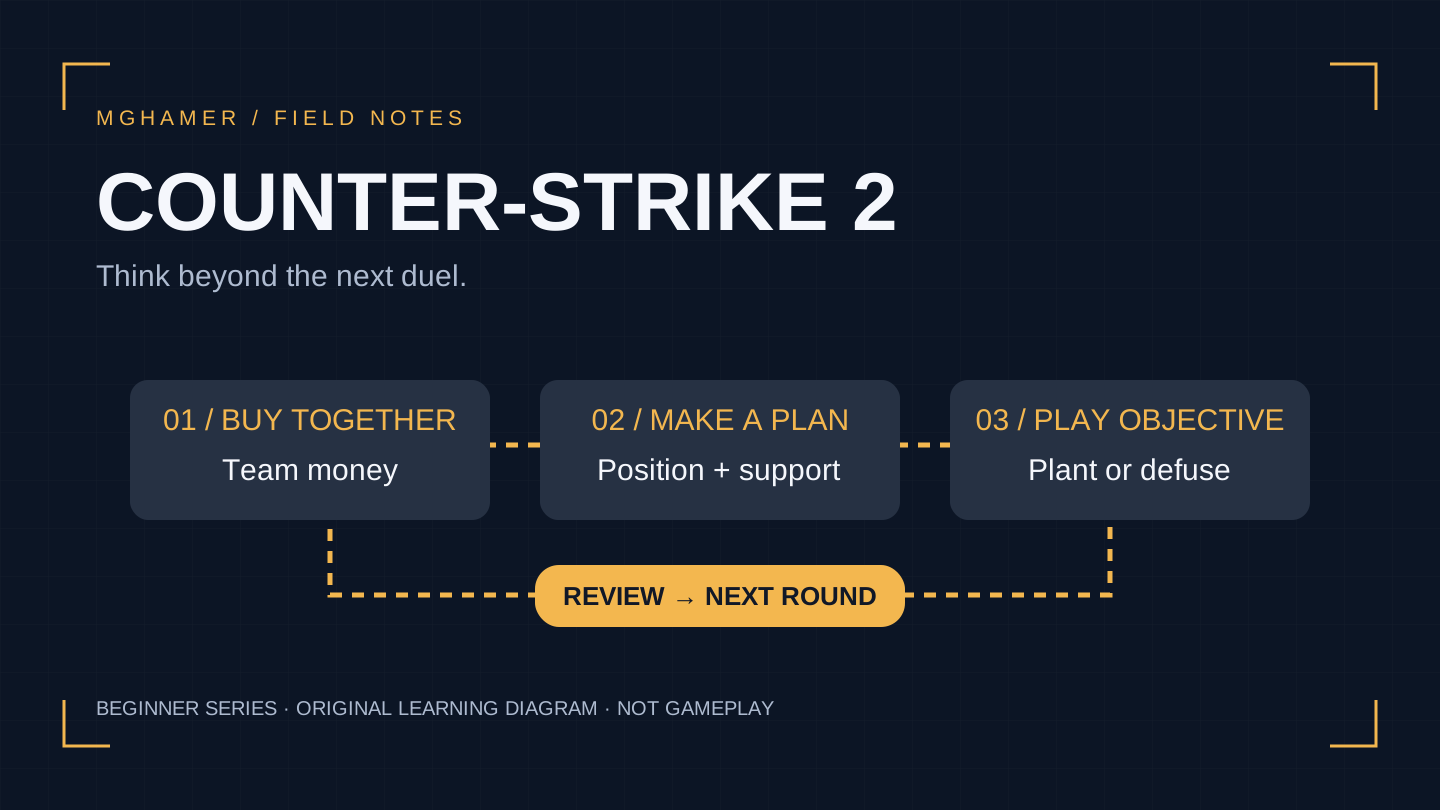
A CS2 broadcast is easier to follow when you stop watching only for eliminations. Before a team wins or loses a round, it is making a chain of decisions about money, space, information and timing. Learn to spot those decisions and even a quiet round becomes a story.
This is a viewing framework, not a prediction model. It uses familiar competitive concepts; team calls and exact strategies differ, and one round rarely proves that a player or team made the wrong choice.
Start with the round’s conditions
At the beginning of each round, ask three questions: Which side is attacking? What is the objective? How much time is left? The attackers need to plant and defend the bomb or eliminate the defenders; the defenders can prevent a plant, defuse the bomb or remove the attackers. The clock changes the value of every rotation and every fight.
Then look at the equipment. A team buying rifles, armour and grenades has different options from a team saving money or working with a limited purchase. Don’t label every cheaper buy an automatic mistake. A team may choose to preserve money for a stronger later round, or spend enough to create a credible chance now. The useful question is: what does this purchase let the team attempt, and what will it leave them able to buy next?
Read the map as space and information
Map control is not simply standing on more parts of the map. It is access to useful routes, safer movement, information about where opponents are—and the ability to deny those advantages to the other side. Watch the minimap when teams probe a lane, take an angle, fall back, or leave a player in a position that can report a rotation.
Try to notice what a team knows versus what it is guessing. A sound, a spotted opponent or a used ability may narrow the possibilities. If the broadcast camera cuts away, the minimap and player count can still tell you whether a site is lightly defended, whether a flank is possible and how much time a retake would require.
Follow utility as a plan
Grenades are not decoration. Smokes can block sightlines; flashes and other tools can make a dangerous angle safer to challenge; incendiary or explosive utility can delay, displace or damage. The result depends on timing, positioning and the response from the opponent. Ask what each use enables: a crossing, a safer entry, a forced reposition, or time to rotate.
A useful viewing exercise is to follow one utility sequence from start to finish. Did the team use it to gain space? Did a teammate move while the opponent was blinded or displaced? Did the defenders keep a counter for a later retake? A grenade that does not produce an immediate elimination can still create value by changing where the opponent can stand.
Watch the trade, not just the duel
When one player is eliminated, check whether a teammate can respond, whether the team keeps its numerical advantage, and whether the lost position exposes another route. A successful trade is not guaranteed to make a round even; location, remaining time, weapons and objective state all matter. The scoreboard gives the number of players left, but the minimap explains what those players can still control.
A five-point round checklist
Use the checklist on a close round and then on a one-sided round. Compare the decisions that happened before the final fight. For more context, pair this guide with Mghamer’s CS2 settings guide and its s1mple and ZywOo profiles. Valve continues to update the demo and replay viewer, so check the current in-game interface if you want to review a match yourself.
The next time a broadcast reaches a pause, look at the economy, the minimap and the unused utility. The round’s most important decision may already have happened before the highlight begins.
Sources & further reading
What did you take away?
Real reactions. Thoughtful discussion. Every comment is reviewed before it appears.
Loading reader contributions…
Sign in to join the discussion